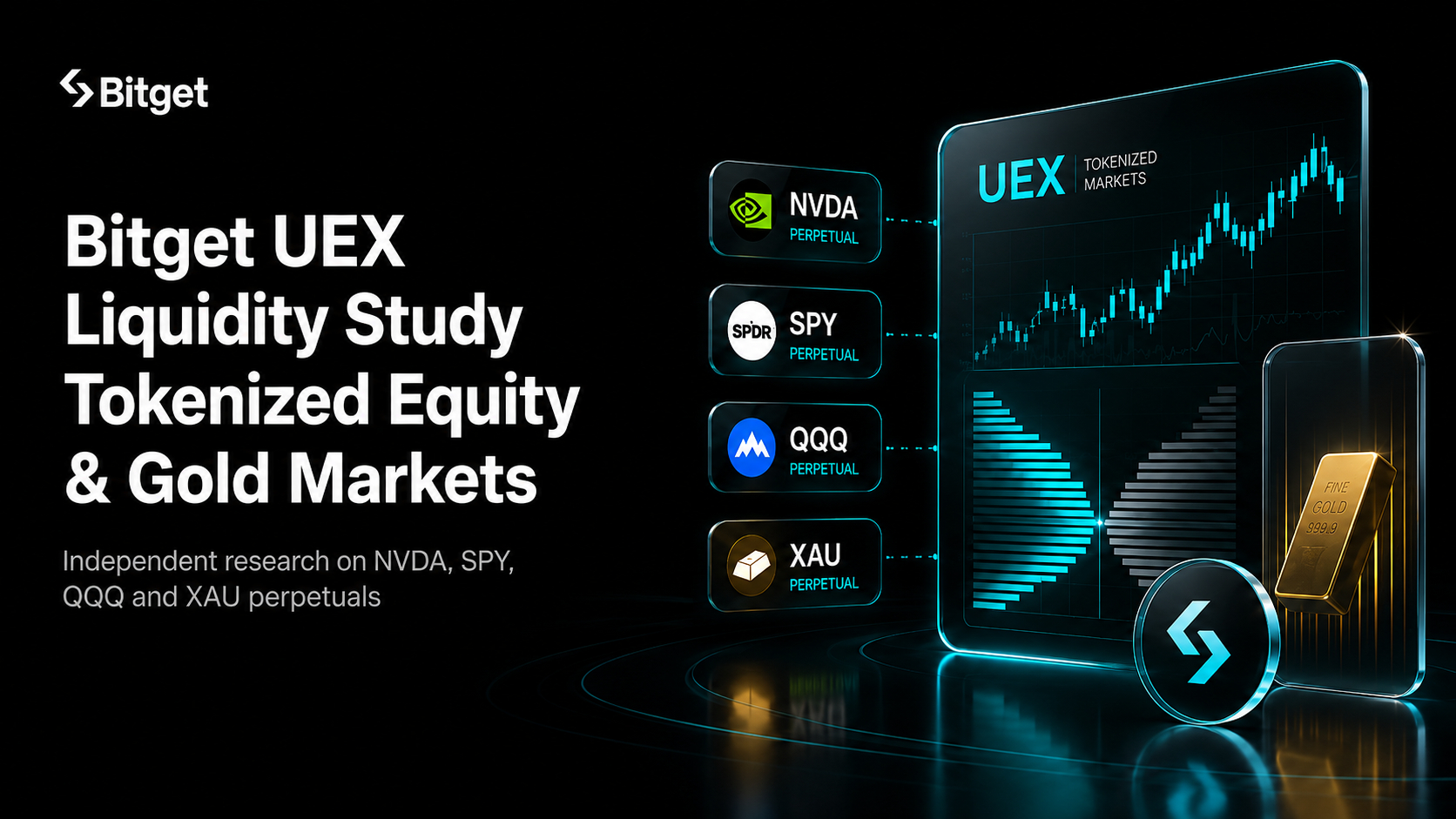
Independent Research Details Liquidity Conditions in Bitget UEX’s Tokenized Equity and Gold Perpetual Markets
[PRESS RELEASE – VICTORIA, SEYCHELLES, August 27th, 2026]
Independent research published by digital-asset analytics firm Block Scholes measured order-book depth, spreads, and slippage across four tokenized real-world-asset (RWA) perpetual futures contracts listed on Bitget’s Universal Exchange (UEX) platform, finding that resting liquidity on the exchange’s Nvidia-tracking contract reached roughly three-quarters of the depth available on Bitget’s own BTC/USDT spot market by mid-May 2026.
The study, published by Block Scholes on June 15, 2026, examined four USDT-margined perpetual contracts that track the price of traditional assets — gold (XAU-USDT), the SPDR S&P 500 ETF (SPY-USDT), Nvidia stock (NVDA-USDT), and the Invesco QQQ Nasdaq-100 ETF (QQQ-USDT). These are derivative contracts that give traders synthetic price exposure to the underlying asset; they do not confer equity ownership, dividends, or voting rights in the referenced companies or funds.
Using order-book snapshots roughly one hour into the U.S. equity session on May 18, 2026, Block Scholes recorded top-of-book spreads of approximately 0.02 basis points on the gold contract, 0.14 basis points on both the SPY and QQQ contracts, and 0.44 basis points on the NVDA contract — meaning less than half a basis point separated the best bid and best ask on three of the four instruments at that point in time. By comparison, the same contracts had quoted noticeably wider spreads three minutes after the U.S. market opened that day, with SPY’s spread narrowing from 1.76 basis points to 0.14 basis points within the hour.
… Continue reading the full article at the original source below.